
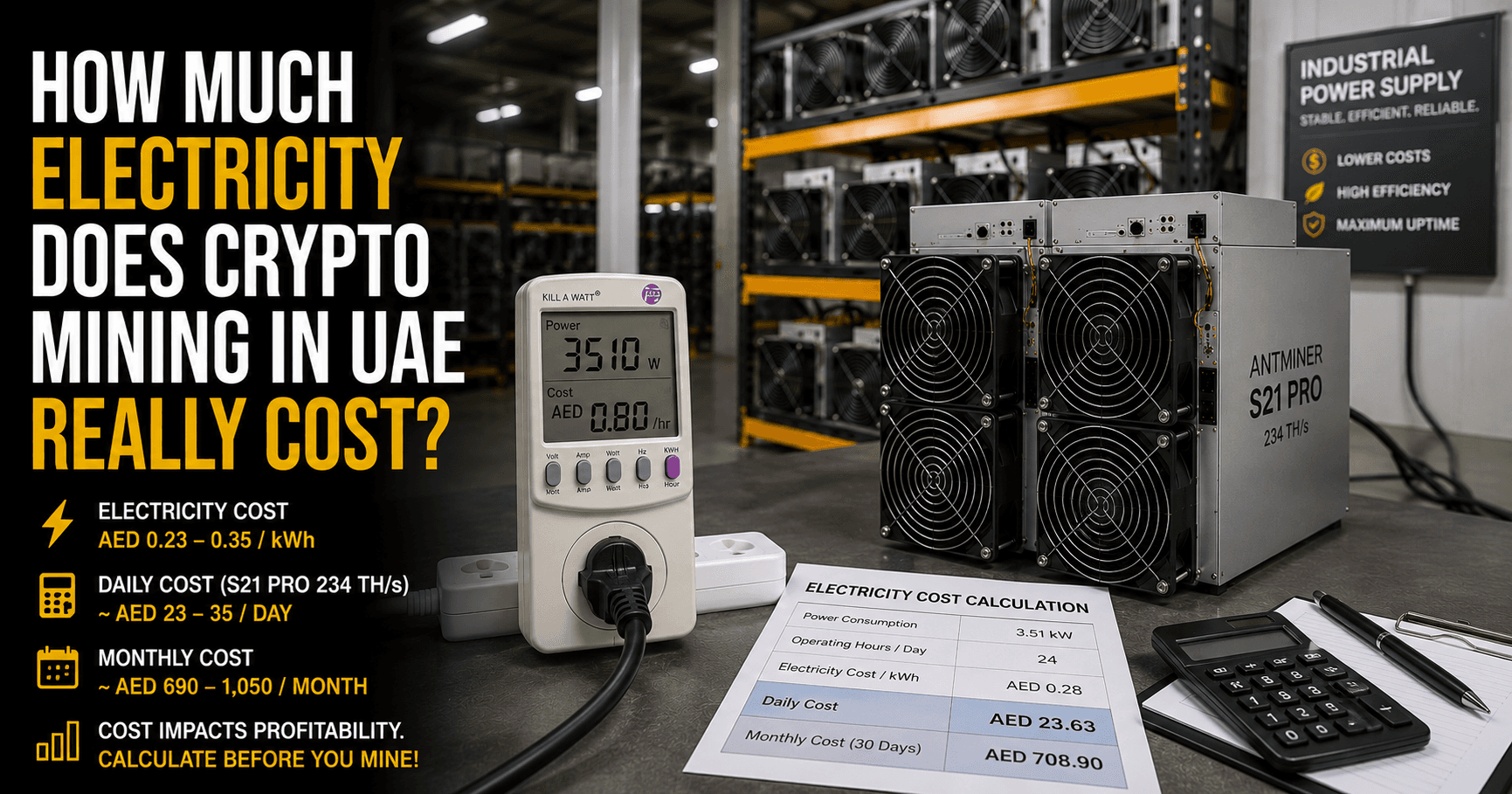
How Much Electricity Does Crypto Mining in UAE Really Cost?
Quick Answer
Running a single ASIC miner in the UAE typically costs between AED 550 and AED 1,400 per month in electricity alone. The exact figure depends on your miner's power draw, your DEWA tariff category, and how many hours it runs.
Residential electricity in Dubai is priced on a progressive slab tariff, from 23 to 38 fils per kWh. Commercial accounts pay a flat 38 fils per kWh, while industrial accounts pay a flat 23 fils per kWh.
That gap explains why almost no serious miner in the UAE runs on a residential rate. This guide shows the exact calculation, so you can estimate your own cost before buying hardware. For the physical setup steps, see how to set up an ASIC miner in the UAE.
Key Takeaways
- Electricity is usually the single largest ongoing cost of running an ASIC miner.
- DEWA charges residential accounts a slab tariff between 23 and 38 fils per kWh.
- Commercial accounts pay a flat 38 fils per kWh, and industrial accounts pay 23 fils per kWh.
- A monthly fuel surcharge and 5% VAT apply on top of the base electricity rate.
- UAE heat adds a real cooling overhead, particularly for air-cooled setups.
- Hosting facilities often secure commercial or industrial rates individtermines your electricity bill.
What Determines Your Electricity Cost
Four factors combine to set your final electricity bill.
Power draw. Every ASIC miner lists a rated power consumption in watts. This is the single biggest input into your cost.
Tariff category. Residential, commercial, and industrial DEWA accounts pay different rates for the same kilowatt-hour.
Runtime. Most miners run 24 hours a day, but planned maintenance or curtailment reduces total consumption.
Cooling overhead. Air conditioning or ventilation to manage heat adds extra consumption beyond the miner itself.
Manufacturer specifications differ by model and firmware setting, so always check your exact unit before budgeting. Overclocked or underclocked configurations change both hashrate and power draw.
UAE Electricity Tariffs Explained
Dubai's utility provider, DEWA, uses different pricing structures depending on account type. Abu Dhabi and other Emirates apply their own local utility rates, which can differ from Dubai's structure.
Account Type
Rate Structure
Approximate Rate
Residential
Progressive slab tariff
23 to 38 fils per kWh
Commercial
Flat rate
38 fils per kWh
Industrial
Flat rate
23 fils per kWh
The residential slab structure charges more per unit as monthly consumption rises. A typical DEWA residential slab breakdown looks like this.
Consumption Band
Rate
0 to 2,000 kWh
23 fils per kWh
2,001 to 4,000 kWh
28 fils per kWh
4,001 to 6,000 kWh
32 fils per kWh
Above 6,000 kWh
38 fils per kWh
A single mid-size ASIC miner easily pushes a household past the first slab within days. That is why residential mining almost always lands in the most expensive tariff band.
DEWA also applies a monthly fuel surcharge, which changes based on global fuel prices, plus 5% VAT on the electricity charge. Always check the current DEWA tariff page for the latest surcharge figure before calculating your bill.
How to Calculate Your Miner's Monthly Electricity Cost
Use this formula to estimate your cost.
Power draw in kilowatts × 24 hours × 30 days × your rate per kWh = monthly electricity cost.
Worked Example: Residential Tariff
A miner drawing 3,500 watts, or 3.5 kW, run continuously for a month uses roughly 2,520 kWh.
At the blended residential slab rate, most of that consumption falls in the 28 to 32 fils range once the first slab is passed. Estimated cost lands near AED 680 to AED 780 before surcharge and VAT.
Worked Example: Commercial Tariff
The same 3.5 kW miner on a flat commercial rate of 38 fils per kWh costs approximately AED 958 per month before surcharge and VAT.
This looks higher than the blended residential estimate at this specific consumption level. The gap widens in the opposite direction once multiple miners push a residential account into the top 38 fils slab permanently.
Worked Example: Industrial Tariff
At the flat industrial rate of 23 fils per kWh, the same miner costs approximately AED 580 per month before surcharge and VAT.
This is the rate range hosting facilities and licensed mining operations typically target. It is the primary reason scaled mining operations rarely run on residential or even standard commercial connections.
UAE Electricity Cost by Miner Size
Power Draw
Monthly kWh
Est. Cost at 23 fils
Est. Cost at 38 fils
2,000 W
1,440 kWh
AED 331
AED 547
3,000 W
2,160 kWh
AED 497
AED 821
3,500 W
2,520 kWh
AED 580
AED 958
5,000 W
3,600 kWh
AED 828
AED 1,368
These figures exclude fuel surcharge, VAT, and any cooling overhead. Treat them as a starting estimate only, not a guaranteed bill.
The Cooling Cost Overheads in UAE Cryptomining
The UAE's climate adds a real, often underestimated cost. Summer ambient temperatures regularly exceed 45°C, well above the ideal operating range for most ASIC hardware.
Air-cooled setups need supplemental ventilation or air conditioning to keep hash boards within a safe temperature range. This overhead is not part of the miner's own power draw, but it still appears on your bill.
Hydro cooling handles heat more efficiently in extreme conditions, since water carries heat away faster than air. Compare both approaches in air cooling versus hydro cooling for UAE mining.
Hosting Electricity Rates vs Running a Miner at Home
Hosting facilities are built around industrial-grade power infrastructure. Providers can often secure lower effective electricity rates than an individual would ever access on a residential connection.
A hosting fee typically bundles electricity, cooling, security, and connectivity into one predictable monthly charge. This removes the surprise of fuel surcharges or slab tariff jumps mid-month.
Choose home mining if your consumption stays low enough to remain in the lowest residential slab.
Choose hosting if you run a full-power ASIC miner and want commercial or industrial-level electricity rates.
Avoid home mining if you plan to scale beyond one machine, since consumption climbs into the most expensive slab quickly.
Review current ASIC hosting plans in the UAE to compare fixed monthly costs against a self-managed setup.
Ways to Reduce Your Cryptomining Electricity Costs in UAE
Several practical steps lower your effective cost per kilowatt-hour over time.
- Choose a commercial or industrial-rated location instead of a residential connection.
- Select newer, more power-efficient ASIC models measured in joules per terahash.
- Use hydro cooling where climate and budget allow, to cut supplemental AC load.
- Avoid running miners in poorly ventilated rooms, which forces harder AC use.
- Monitor consumption monthly to catch slab-tariff creep before it compounds.
Efficiency gains compound over a miner's operating life. A model with lower watts per terahash saves money every single month it runs.
FAQ ASIC Miner’s Electricity Cost in UAE
Is electricity the biggest cost of mining in the UAE?
Yes. For most ASIC mining operations in the UAE, electricity is the largest ongoing expense. Over the life of a miner, power costs often exceed maintenance, repairs, and other operating fees, making electricity rates one of the biggest factors affecting mining profitability.
Does DEWA charge the same rate for every account type?
No. DEWA uses different pricing structures based on the account type. Residential customers usually pay progressive slab rates, while commercial and industrial customers pay different flat tariffs. The rate you pay depends on your electricity account and usage category.
Can I lower my tariff by mining less?
Mining for fewer hours will reduce your total electricity consumption and monthly bill. However, it also lowers your miner's operating time, which means you earn less cryptocurrency because your hashrate runs for fewer hours.
Do hosting fees already include electricity?
Many ASIC hosting providers in the UAE include electricity in a fixed monthly hosting fee based on your miner's power consumption. However, pricing and what's included can vary between providers, so always check the terms before signing up.
How much does cooling add to my electricity bill?
Cooling costs depend on your setup, room temperature, and the time of year. During the UAE's hot summer months, air conditioning can significantly increase electricity usage, making cooling an important part of your total mining costs.
Why do industrial rates matter for mining profitability?
Industrial electricity rates are often lower than residential rates, which helps reduce the cost of running ASIC miners. Since electricity is usually the biggest ongoing expense, lower rates can improve your mining profits and shorten the time it takes to recover your investment.
Comments