
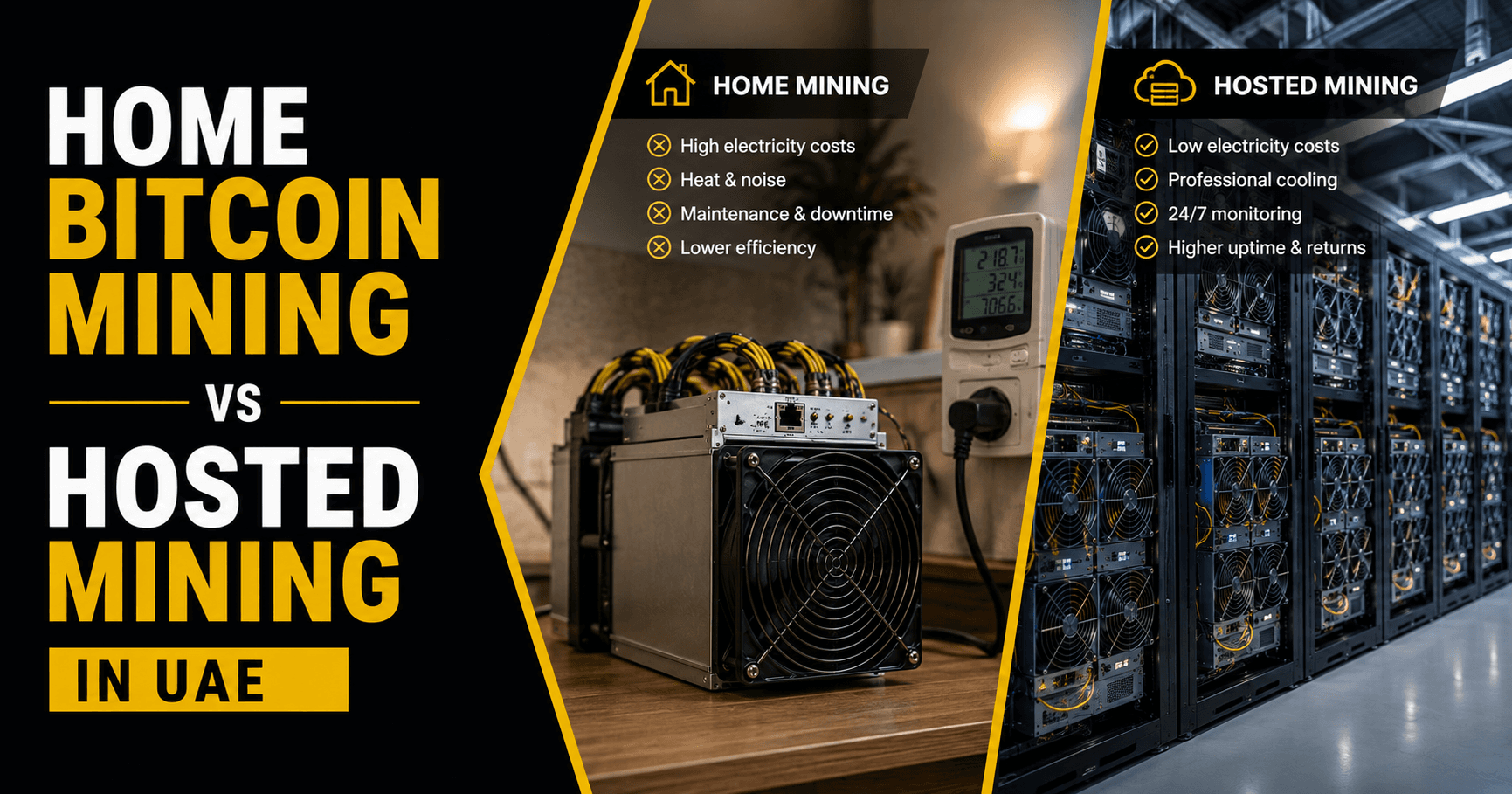
Hosted mining outperforms home mining for almost every serious buyer in the UAE. Residential electricity tariffs, extreme ambient heat, and noise limits make home mining difficult to run profitably at any real scale.
Home mining can still make sense for a single low-power unit in a well-ventilated space, run more as a hobby than an investment. Anything beyond that, hosted mining offers lower effective electricity rates, professional cooling, and far higher uptime than most home setups can match.
This guide compares both paths in detail, so you can decide which fits your goals, budget, and risk tolerance.
Key Takeaways
- UAE residential electricity tariffs are progressive and expensive, while hosting facilities access flat commercial or industrial rates.
- ASIC miners produce significant noise, often 75 to 85 decibels, which is difficult to manage in a home setting.
- UAE ambient heat regularly exceeds 40°C, straining home cooling systems that were never built for this load.
- Hosting facilities typically deliver uptime above 98%, supported by 24/7 monitoring and on-site repair.
- Home mining remains legal for personal use, but commercial-scale operations fall under stricter regulatory expectations.
- The right choice depends on scale. A single small unit can work at home; anything larger favors hosting.
How Home Mining Works in the UAE
Home mining means running an ASIC miner from a house, villa, or private garage, with the owner handling every part of the setup and upkeep.
UAE’s Electricity Tariffs at Home
DEWA charges residential accounts on a progressive slab tariff, rising from roughly 23 to 38 fils per kWh as monthly consumption increases. A single mid-power ASIC miner running continuously can push a household electricity bill into the highest slab within days.
This structure penalizes exactly the kind of constant, heavy electricity draw that mining requires. The full cost breakdown, with worked examples, is in how much electricity crypto mining really costs in the UAE.
UAE’s Heat and Cooling Limitations
UAE summer temperatures regularly exceed 40°C outdoors. Household air conditioning is built for comfort cooling, not for offsetting the constant heat output of an ASIC miner running around the clock.
Without proper airflow planning, home-mined machines run hotter than their rated range, which throttles hashrate and accelerates hardware wear over time. See how heat affects ASIC miner lifespan for the longer-term impact.
ASIC Miner’s Noise and Safety
ASIC miners are genuinely loud, often in the 75 to 85 decibel range, comparable to a running vacuum cleaner or louder. This is difficult to live with in most residential settings, particularly shared walls or small villas.
Heavy, continuous power draw on household wiring not built for it also raises real electrical safety concerns. A dedicated, properly rated circuit is essential, and even then, most home electrical systems were not designed for this kind of sustained industrial load.
How Hosted Mining Works in the UAE
Hosted mining places the owner's hardware inside a facility built specifically for mining loads. The owner retains ownership of the machine but pays the facility a monthly fee, usually tied to power draw.
Industrial Electricity Rates of Hosted Mining
Hosting facilities operate on commercial or industrial DEWA tariffs, both flat rather than progressive, and both meaningfully lower than the top residential slab.
Some UAE-region hosting providers advertise effective rates as low as a few cents per kilowatt-hour, achieved through negotiated bulk power agreements that individual residential accounts cannot access.
Professional Cooling Infrastructure in Hosted Mining
Hosting facilities are built around the cooling problem from the ground up, using air containment systems, hydro cooling, or immersion cooling designed for sustained, high-density mining loads.
This keeps chip temperatures stable regardless of outside conditions, protecting both hashrate and hardware lifespan. Compare cooling approaches in air cooling versus hydro cooling for UAE mining.
Uptime, Security, and Support of Hosted Mining
Professional facilities typically deliver uptime above 98%, backed by 24/7 monitoring, physical security, and on-site technical staff who can diagnose and repair issues immediately. A home setup relies entirely on the owner noticing and fixing problems, often with no local repair support.
Home Mining vs Hosted Mining: Side-by-Side Comparison
Factor
Home Mining
Hosted Mining
Electricity rate
Residential slab tariff, 23 to 38 fils/kWh
Commercial or industrial flat rate
Cooling
Household AC, often insufficient
Purpose-built air, hydro, or immersion cooling
Noise
Full exposure, 75 to 85 dB
Contained within the facility
Uptime
Depends entirely on owner monitoring
Typically 98%+ with 24/7 oversight
Setup and maintenance
Fully owner-managed
Handled by the facility
Scalability
Limited by household power and space
Scales to multiple units easily
Best suited for
A single low-power unit, hobby-scale
Any serious or scaled operation
One Year Cost Comparison: Home Bitcoin Mining vs Hosted Mining
Electricity is the largest recurring cost in either scenario, so it drives most of the gap between the two paths.
A miner drawing 3,500 watts run continuously for a year consumes roughly 30,660 kWh. At a blended residential slab rate, this lands well into the most expensive tariff tier for nearly the entire year, since a single unit alone pushes past the lowest slab within the first week or two of the month.
The same machine on an industrial hosting rate consumes the same electricity but at a flat, lower rate throughout, with no slab escalation as consumption rises.
Add in the home setup's need for supplemental cooling during summer months, and the effective gap between the two paths widens further.
Run your own numbers using the full formula and worked examples in the UAE electricity cost guide, then compare against current crypto hosting plans.
Is Home Mining Legal in the UAE?
Crypto mining is legal in the UAE, and personal, small-scale home mining generally falls outside the licensing requirements that apply to commercial operations.
Larger or business-scale mining activity typically requires proper licensing through a free zone authority or under the broader virtual assets regulatory framework.
Rules can evolve, so always verify current requirements before scaling beyond a single personal-use machine. For the full picture, read is crypto mining legal in the UAE in 2026 and the complete UAE cryptocurrency regulation guide.
Which Option Fits Which Type of Miner
Choose home mining if you own a single low-power unit, have a well-ventilated space, and are mining more as a hobby than an income strategy.
Choose hosted mining if you are running a full-power ASIC miner, want lower electricity costs, or plan to scale beyond one machine.
Avoid home mining if you live in an apartment, share walls with neighbors, or lack a dedicated high-amperage circuit.
Avoid hosted mining if your budget cannot cover both the hardware and an ongoing monthly hosting fee, though this fee is often offset by the electricity savings alone.
For most buyers evaluating this decision seriously, review is Bitcoin mining profitable in the UAE and the full 2026 UAE mining cost and legal breakdown alongside this comparison before committing to either path.
FAQ About Home vs. Hosted Mining
Is home Bitcoin mining actually legal in the UAE?
Yes, personal Bitcoin mining at home is generally allowed in the UAE and usually does not require a commercial license. However, if you plan to operate a larger mining business or run multiple machines commercially, you may need to register your business and obtain the required approvals. Always check the latest regulations before expanding your operation.
Why is hosted mining usually cheaper than home mining despite the monthly fee?
Hosting facilities often have access to commercial or industrial electricity rates that are lower than residential tariffs. Even after paying the monthly hosting fee, many miners save money because they benefit from lower power costs, professional cooling, and reduced maintenance expenses.
Can I run more than one ASIC miner at home in the UAE?
Yes, but it can become challenging as you add more miners. Multiple ASIC miners generate significant heat, noise, and electricity demand, which may require electrical upgrades and increase your power costs. For larger setups, professional hosting is usually the more practical and cost-effective option.
How much noise does an ASIC miner actually produce?
Most ASIC miners produce between 75 and 85 decibels of noise while operating. That's about the same as a vacuum cleaner or even louder, making them unsuitable for living rooms, bedrooms, or other quiet areas in most homes.
What uptime should I expect from a hosting facility?
A reliable UAE ASIC hosting provider typically aims for more than 98% uptime. Professional facilities use stable power, continuous monitoring, backup systems, and on-site technical support to keep miners running with minimal interruptions.
Do I lose ownership of my miner if I use a hosting facility?
No. You remain the legal owner of your ASIC miner at all times. The hosting provider simply stores, powers, cools, secures, and maintains your equipment in exchange for a monthly hosting fee.
Comments