
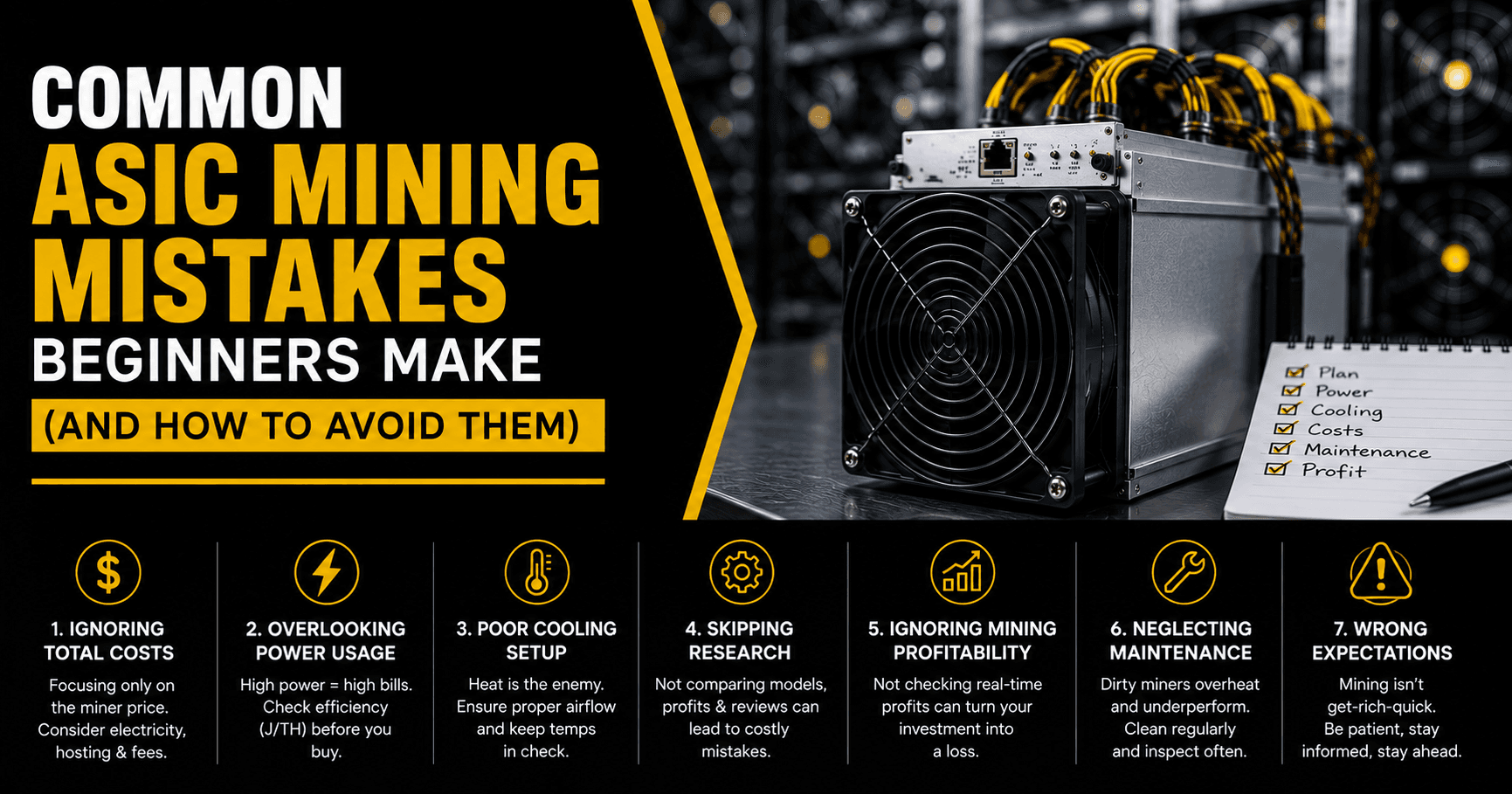
The most common ASIC mining mistakes beginners make are ignoring electricity costs before buying, choosing hashrate over efficiency, mining at home without planning for UAE heat, skipping routine maintenance, and running machines on unrated electrical circuits.
Every one of these mistakes is avoidable with a small amount of planning before hardware arrives. Most of them cost far less to prevent than to fix after the fact.
This guide walks through each mistake, why it happens, and the specific fix, with links to deeper guides on each topic.
Key Takeaways
- Electricity cost, not hardware price, usually decides whether a miner is profitable.
- Efficiency (J/TH) matters more than raw hashrate for long-term returns.
- UAE heat turns poor setup planning into throttled hashrate and shortened hardware life.
- Skipping maintenance is the single most common cause of preventable hardware failure.
- Unrated electrical circuits create real fire risk, not just performance issues.
- Ignoring early warning signs, such as fan errors or a burnt smell, turns small problems into expensive repairs.
- Unrealistic profit expectations, ignoring difficulty and fees, lead to disappointing first-year results.
Common ASIC Mining Mistakes Beginners Make
Mistake 1: Ignoring Electricity Costs Before Buying
This is the single most common and most expensive mistake beginners make. Electricity, not the hardware itself, is usually the largest cost over a miner's operating life.
Buyers often calculate potential earnings without checking their actual electricity rate first. A machine that looks profitable on a spec sheet can lose money the moment residential tariffs are applied.
The fix: Calculate your expected monthly electricity cost before buying, not after. Review the full formula and worked examples in how much electricity crypto mining costs in the UAE.
Mistake 2: Buying Based on Hashrate Alone
A higher hashrate number looks impressive, but it says nothing about how much electricity that hashrate costs to produce. Two miners with similar hashrate can have very different running costs.
Beginners frequently choose the highest hashrate they can afford, without checking the machine's efficiency rating in watts per terahash. This mistake compounds every single day the miner runs.
The fix: Compare efficiency, not just hashrate, before buying. See the full ranked breakdown in which ASIC miner is most profitable.
Mistake 3: Mining at Home Without Planning for UAE Heat
ASIC miners generate serious, constant heat, and UAE summer temperatures regularly exceed 40°C. Beginners often plug a miner in wherever there is a free outlet, without considering airflow.
The result is throttled hashrate, elevated component temperatures, and accelerated hardware wear, all while the owner assumes the machine is simply running normally.
The fix: Plan the physical location and airflow before the miner arrives, or consider hosting to remove the problem entirely. Compare both paths in home mining versus hosted mining in the UAE.
Mistake 4: Skipping Routine Maintenance
A miner does not usually announce that it needs cleaning. It just quietly loses hashrate as dust builds up and firmware throttles performance to protect the chips.
Beginners often assume a running miner is a healthy miner. By the time a real problem appears, dust and heat have already done months of damage.
The fix: Follow a consistent cleaning and inspection schedule from day one. The full procedure and timing intervals are in the ASIC miner maintenance guide.
Mistake 5: Using Unrated Electrical Circuits
ASIC miners draw far more current than typical household devices. Plugging one into a standard outlet or a shared circuit not built for sustained high-amperage loads is a common and genuinely dangerous mistake.
This is not just a performance issue. Loose connectors, overloaded circuits, and undersized cabling can generate heat at connection points, raising real fire risk.
The fix: Use a dedicated, correctly rated circuit matched to your miner's specifications. The wiring requirements are covered in how to set up an ASIC miner in the UAE.
Mistake 6: Ignoring Early Warning Signs
A failing ASIC miner rarely breaks without warning first. Beginners often notice something odd, a fan sounding different, a slightly higher temperature, and keep running the machine anyway.
Warning Sign
Likely Cause
What To Do
Persistent hashrate drop
Overheating, weak PSU, hashboard issue
Check dashboard, temperatures, and pool connection
Fan error or grinding noise
Fan wear, dust, blocked airflow
Stop and inspect before continuing
Burnt smell or discoloration
Electrical overheating, short circuit
Shut down immediately, do not restart
Frequent reboots
Unstable power, overheating, firmware fault
Check power stability and logs
Rising hardware error rate
Chip instability, heat, voltage issue
Compare against your normal baseline
The fix: Treat any of these signs as a reason to stop and investigate, not a reason to wait and see. Continuing to run a struggling miner almost always turns a cheap fix into an expensive one.
Mistake 7: Unrealistic Profit Expectations
Beginners often calculate expected earnings using today's coin price and today's network difficulty, then assume those numbers will hold steady. Difficulty rises over time, pool fees apply to every payout, and hardware depreciates as newer models launch.
The result is a first-year outcome that falls short of the spreadsheet built on day one.
The fix: Build expectations around a realistic operating horizon, not a single snapshot. See the full ASIC miner lifespan and ROI guide for how to plan around economic lifespan rather than a best-case estimate.
Mistake 8: Buying Hardware Without a Location Plan
Some beginners buy a miner first and figure out where to run it afterward. This backwards order of operations often forces a compromise, a hot spare room, a noisy shared space, or a circuit that was never designed for the load.
The fix: Decide between home mining and hosting before buying hardware, not after. The decision changes which models make sense and how much you should budget overall. Compare both paths fully in home mining versus hosted mining in the UAE.
Quick Mistake-Avoidance Checklist
- Calculate your real electricity cost before buying, using your actual DEWA tariff category.
- Compare efficiency (J/TH), not just hashrate, across candidate models.
- Decide on home mining or hosting before hardware arrives.
- Plan airflow and circuit requirements ahead of setup day.
- Set a recurring cleaning and inspection schedule from the first week.
- Treat any warning sign as a reason to pause, not push through.
- Base profit expectations on a multi-year horizon, not today's numbers alone.
FAQs About ASIC Mining Mistakes
What is the single biggest mistake beginners make in UAE mining?
The biggest mistake is underestimating electricity costs. Power is usually the largest ongoing expense in ASIC mining, and many beginners focus only on the miner's purchase price without calculating how electricity costs will affect long-term profitability.
Is it a mistake to mine at home in the UAE?
Not necessarily. Home mining can work well if you have proper ventilation, sufficient electrical capacity, and a way to manage the heat and noise. However, many beginners overlook these factors, which can lead to higher costs and operating problems.
How do I know if a hashrate drop is serious or normal?
Small changes in hashrate are normal and can happen from time to time. However, if your miner continues to perform below its normal hashrate after restarting it, checking the cooling system, and confirming the mining pool is working properly, you should investigate the issue further.
Should I buy a used ASIC miner as a beginner?
A used ASIC miner can be a good way to save money, but it comes with more risk than buying new. If you choose a used machine, make sure it has been tested under normal operating conditions and inspect its condition carefully before purchasing.
Is it a mistake to skip maintenance if the miner seems to be running fine?
Yes. Even if the miner appears to work normally, dust and heat slowly reduce its efficiency over time. Regular cleaning and maintenance help prevent performance loss, extend the miner's lifespan, and reduce the risk of unexpected failures.
Can these mistakes really lead to a fire risk, or is that overstated?
Yes, the risk is real. ASIC miners draw a large amount of electricity continuously, and overloaded circuits, damaged cables, or poor electrical connections can overheat and become a fire hazard. Using proper wiring, quality electrical components, and regular inspections helps keep your mining setup safe.
Comments